Friday, 14 September 2018

William Cribb

William Eardley Cribb was a maker of watches, chronometers and clocks of above-average quality.  His good reputation was especially justified by the excellent performance of his chronometers – such that, according to Mercer, he became a supplier to the Admiralty.  His was a business which could have grown and continued through successive generations, but, having had no children, it ceased with his death at the relatively early age of sixty*.

William had been born in London on Christmas Eve, 1814, and grew up at 58 Theobalds Road, Bloomsbury, between Chancery Lane and Russell Square.  From the early 1820s he lived and traded from premises on Southampton Row, successively at numbers 17, 30 and 146 – the latter nowadays being an Indian Restaurant.

Around 1853-55 Cribb developed his business by taking over that of Birchall & Appleton at 30 Southampton Row following Appleton’s death in September 1852.  The partners had consolidated their own good standing by acquiring in 1830 the business/premises of Robert Molyneux & Son – Molyneux having been especially notable for his work on auxiliary compensation for marine chronometers, as discussed in my article on James Eiffe.

The British Museum holds two examples of Cribb’s work.  One of these, with movement number 3715, circa-1860, features an escapement of the type known as Cole's Resilient – invented in 1830 by James Ferguson Cole.  This obviates the banking pins normally used to constrain movement of the lever by the utilisation of specific shaping of the escape wheel teeth and angularity of the pallets.

© Trustees of the British Museum

This is another of Cribb’s movements, number 3824, which is a free sprung chronometer, the quality of which appears first rate in this photograph, for which thanks are due to ‘radger’ who posts on the Watchuseek forum:


* I have seen a contention that Gibbs had a son named Arthur, but I have been unable to confirm this.  A person with this name is mentioned as an executor of William’s will, but he was an upholsterer born the same year (1814) – so was perhaps a cousin.  William’s estate amounted to ‘under £1,500,’ so his commercial success should probably be considered as having been moderate only.

Friday, 1 June 2018

John Cashmore

Earlier this year I became interested in John Cashmore, a later-nineteenth century London watchmaker.  Although not especially innovative, Cashmore's quality was consistently  good and he achieved a reputation for excellence.  Here, below, is an example of his output:


Described as follows:

A Minute Repeater in 18ct. Gold Hunter case and with keyless, lever movement. Signed John Cashmore, London, no.5955, 1881.  A frosted gilt three-quarter plate movement jewelled to the centre with screwed chatons, free sprung bimetallic compensation balance with diamond endstone, gold cuvette, white enamel dial with roman numerals, subsidiary seconds, gold hour and minute hands, polished case with engraved monogram and repeat slide in the band, casemaker's initials GAP,  diameter 56mm. (Description and photograph courtesy of Christie's.)

Over time 'John Cashmore' became a brand, watches by this name being marketed for some time after his retirement in 1899.

My illustrated article on John Cashmore features in the June issue of 'Clocks' magazine.


Wednesday, 23 May 2018

Richard Thorneloe

Anyone looking for a straightforward late-nineteenth century English pocket watch will inevitably, sooner or later, encounter one bearing the maker’s name of John Forrest.  Most will be found to have nothing to do with the man himself and many will be of mediocre quality.  But that is not to say, despite Mr Forrest’s own, spurious claim to be, “Chronometer maker to the Admiralty,” that they are necessarily any less well made than those he did make.  And, after Forrest’s death, ironically, some made by the man – arguably the only one - who had a right to use the name, were actually purchased by the Admiralty because of their very high quality.

After Forrest’s death (in 1871) the brand was sold to Richard Thorneloe for £20 in 1891.  However, in the meantime another Coventry maker, Charles John Hill (Russel House, Chapel Fields), had taken to marketing watches inscribed with the Forrest name.

Thorneloe was determined to affirm and secure the rights he believed his outlay should have brought him.  Accordingly, in 1893, he instigated an action in the High Court.  This, however, failed and ‘John Forrest’ watches continued to be made by Hill and others.

Prior to his difficulties with the John Forrest brand Thorneloe had established and developed a successful business within the Coventry watchmaking community; it was of sufficient size in 1871 to be employing 6 men and 7 boys.

Whilst the ‘original’ Forrest established a marketability based on a perception of quality and a false claim, Thorneloe achieved a reputation founded on actual quality which was verifiably endorsed by Admiralty purchase.  This is evidenced by a deck watch sold by Sotheby’s in 2016:

Courtesy of Sotheby’s


It was entered in the 1904-05 trial at Greenwich Observatory, and its accuracy was not bettered by any of the other instruments tested at the same time.  This was attributable to its well-made movement which featured a spring detent chronometer escapement and compensated balance.  Thorneloe had however gone one step further with this instrument by incorporating a karrusel, as developed and patented by the Danish maker, Bahne Bonniksen.

I have recently completed a comprehensive article on Thorneloe and anticipate publishing it later this year or in 2019.

Tuesday, 3 April 2018

The Brockbanks

Currently on offer at Pieces of Time is this beautiful multiple dial verge by Brockbank.  The subsidiary dials provide Hours, Seconds, Moon-age and Day of Month.  This degree of complexity and the case decoration are typical of a watch made in the late eighteenth century for export to the Far East.  From the movement number it is safe to attribute a making date of 1786-90.

 Courtesy of Pieces of Time

The Brockbank business was started by John in 1769 in Old Jewry, London.  He took on his younger brother, Miles as his apprentice that same year.

The lives and work of the Brockbanks – including notable productivity, involvement in the Arnold/Earnshaw dispute, bankruptcy, sons and a nephew aspiring to maintain the name in watchmaking, etc. – are covered in an excellent article by A. D. Stewart, published in Antiquarian Horology, December 2015.


Courtesy of Pieces of Time

Access to this sort of in-depth (19 pages and many illustrations) article underpins the very good value for money provided by membership of the Antiquarian Horological Society.  This is further enhanced by the addition to the resources available to members of the digitised archive of the Horological Journal from its first issue in 1858 to 2000.  It’s well worth a visit to here for details of membership.

Friday, 19 January 2018

In Print

In response to an e-mail enquiry - thanks for your interest in my work Johann - here's a list of my recent print-published horology articles:

Title
Subject
Publication
Issue Date
Grant of Fleet Street
John Grant and his son
Clocks Magazine
February 2016
Alexander Watkins 1
Watkins and his family
Clocks Magazine
April 2016
Alexander Watkins 2
Watkins and his family
Clocks Magazine
May 2016
Man or Brand?
Ralph and David Gout
Antiquarian Horology
June 2016
John Poole
John Poole
Clocks Magazine
August 2016
Ahead of its Time
George Sanderson
Clocks Magazine
March 2017
Impoverished Innovator
Joseph Berrollas
Antiquarian Horology
June 2017
The Circumvoluting Brand
Sigismund Rentzsch
Clocks Magazine
September 2017
Margetts
George Margetts
Clocks Magazine
December 2017

Monday, 13 November 2017

The Luftwaffe B-Uhr

My aesthetic tastes remain greatly influenced by my boyhood experiences of the 1950s.  There was a cosiness to illustrators’ imagination of space travel, and the ‘look’ of rocket ships, spacesuits/helmets in the Eagle’s Dan Dare strip is still one I enjoy.  Science fiction themes were frequently encountered, very impressively so in the styling of American –and eventually, if in a rather diluted form – English cars.  Such things also began to feature as subject matter in the new Pop Art that emerged as the next decade was approached.  But while these things looked to the future, something from the recent past also loomed very large: World War II.  Our comics were full of depictions of the conflict and aerial warfare was a particular favourite.  Naturally, as the victors, the Brits were the good guys, the Jerries bad, and the Spitfire was the king of the skies.  The Airfix kit which was to blame for me accidentally squirting polystyrene cement all over a brand new school blazer was of the good old Lancaster – I was very conventional in revering the look and exploits of that great lumbering bomber.

But I was also a bit odd:  secretly, I studied everything I could about the German Luftwaffe.  Although at that stage not contesting the right and wrongs of the war, I was finding nearly all aspects of the Luftwaffe much more charismatic than the RAF versions – the planes, the insignia and badges, the uniforms, etc.  And that is still my take.  I like the menacing look and specification of such machines as the Ju87, the Do17 and the Me262.

And in the realms of horology, the watches issued to German flying personnel are prized collectibles today.  Foremost of the models was that primarily intended for the use of an aircraft’s Observer – usually the mission’s navigator.  Known as the Beobachtungsuhr – often abbreviated to B-Uhr – and specified by the Reichsluftfahrtministerium (Air Ministry), five makers supplied the watches to the Luftwaffe: A Lange & Sohne, IWC, Laco (Lacher & Co), Stowa and Wempe.  Their brief was to build instruments with a case diameter of 55mm, chronometer-quality movement with a Breguet type balance spring, a hackable seconds hand, a crown with enough protrusion to allow a glove hand to wind it, and a strap allowing wear over the sleeve of flight clothing.  The makers met the basic functional requirements by using modified variants of their pocket watch movements.

The best of the makers is A Lange & Sohne, then and now considered supreme amongst the manufacturing houses located in the German town of Glashutte.  The firm utilised its 48/1 movement for timepieces made between September 1940 and April 1945 for the Luftwaffe and the Kriegsmarine.  The Luft B-Uhr had two iterations – initially with a very simple dial (Type A), and, from 1942, with a more distinctive layout featuring a small, inner, concentric hours track (Type B):

Left: Lange & Sohne B-Uhr type A; Right: Lange & Sohne B-Uhr type B.  Courtesy of @TimeTitans

Left: Lange & Sohne B-Uhr Movement; Right: Lange & Sohne B-Uhr Inside Rear Cover.
 © The Swiss Watch Co. (UK) Ltd 1996-2017

The earlier, Type A, is today the less easy to find.  For both versions it is possible that data on the rear cover (inner face) reflects the fact that L&S sometimes lacked the capacity to assemble the complete timepiece.  As a result one of the following list of makers may appear in the Hersteller field: Huber (Munich), Felsing (Berlin), (Schieron) Stuttgart, Schätzle & Tschudin (Pforzheim), Wempe (Hamburg).

Whilst there is general similarity of appearance between the watches produced by the five manufacturers, some subtle differences are to be seen in terms of the crowns, hands and dial numerals – comparison of the Type A versions made by IWC and Stowa, as below, (left, and right, respectively), illustrate this – especially notable is the style in which the numbers 6 and 9 are rendered on the IWC:

Left: IWC Type A. Courtesy www.dieselpunks.org; Right: Stowa Type A.
 Courtesy Lockdale Coins Ltd

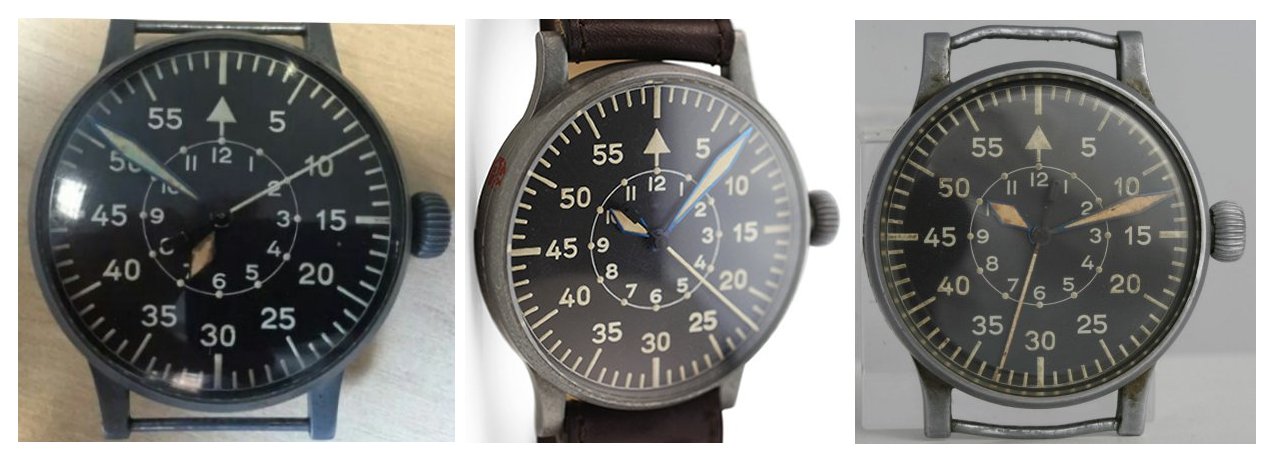
The later, Type B, versions show similar small detail variances.  Here, below, left to right, are those by Laco, Stowa and Wempe:


Of these the most rare is the Stowa – on the company’s contemporary web-site it is stated that total production may have been as little as 42 pieces!

And here are the four movements not already shown, left to right: IWC; Laco; Wempe; Stowa


The stainless steel cases were often finished in grey paint/lacquer and the Reichsluftfahrtministerium reference number, FL 23883 was commonly stamped into the side of the case at the 9 o’clock position.  The serial number (Werk nr.) was stamped into the outer face of the rear cover.

These watches did not remain in the possession of the Luftwaffe flyers – they were issued to them, mission by mission, to be returned on safe arrival back at base. 


An impressive watch by virtue of the clarity of the dial layouts and the case size. In recent times there has been enough interest for all the original manufacturing houses/brand names, excepting A Lange & Sohne, to be offering ‘re-interpretations’ (of both the A and B Types) some of which look very much like the originals, but which are somewhat smaller in overall dimensions.

Monday, 11 September 2017

Christiaan van der Klaauw

Prompted by my research and writing on George Margetts – see here - I have been looking at the Astronomical Watches of Christiaan van der Klaauw.

Van der Klaauw produced his first astronomical clock in 1974.  Watch manufacture followed twenty years later with the Satellite du Monde model.  This featured time, day, date, moon-phase and noon-location indicator.  Just in time for the new millennium, the Planetarium model followed, claimed as embodying, “the smallest mechanical planetarium in the world.”

Planetarium models remain in production along with other current model families based on either moon phase or the stars.

Much as I admire the skills of the ‘old’ makers of pocket watch-scale astronomical pieces, I think I am even more impressed by what CVDK achieves with these relatively small wristwatches.


You may well find yourself spending quite a lot of time on this website: http://www.klaauw.com/eng