|
Title
|
Subject
|
Publication
|
Issue Date
|
|
Grant of Fleet Street
|
John Grant and his son
|
Clocks Magazine
|
February 2016
|
|
Alexander Watkins 1
|
Watkins and his family
|
Clocks Magazine
|
April 2016
|
|
Alexander Watkins 2
|
Watkins and his family
|
Clocks Magazine
|
May 2016
|
|
Man or Brand?
|
Ralph and David Gout
|
Antiquarian Horology
|
June 2016
|
|
John Poole
|
John Poole
|
Clocks Magazine
|
August 2016
|
|
Ahead of its Time
|
George Sanderson
|
Clocks Magazine
|
March 2017
|
|
Impoverished Innovator
|
Joseph Berrollas
|
Antiquarian Horology
|
June 2017
|
|
The Circumvoluting Brand
|
Sigismund Rentzsch
|
Clocks Magazine
|
September 2017
|
|
Margetts
|
George Margetts
|
Clocks Magazine
|
December 2017
|
Friday, 19 January 2018
In Print
In response to an e-mail enquiry - thanks for your interest in my work Johann - here's a list of my recent print-published horology articles:

Monday, 13 November 2017
The Luftwaffe B-Uhr
My aesthetic tastes remain
greatly influenced by my boyhood experiences of the 1950s. There was a cosiness to illustrators’
imagination of space travel, and the ‘look’ of rocket ships, spacesuits/helmets
in the Eagle’s Dan Dare strip is
still one I enjoy. Science fiction
themes were frequently encountered, very impressively so in the styling of
American –and eventually, if in a rather diluted form – English cars. Such things also began to feature as subject
matter in the new Pop Art that emerged as the next decade was approached. But while these things looked to the future,
something from the recent past also loomed very large: World War II. Our comics were full of depictions of the
conflict and aerial warfare was a particular favourite. Naturally, as the victors, the Brits were the
good guys, the Jerries bad, and the Spitfire was the king of the skies. The Airfix kit which was to blame for me
accidentally squirting polystyrene cement all over a brand new school blazer
was of the good old Lancaster – I was very conventional in revering the look
and exploits of that great lumbering bomber.
But I was also a bit
odd: secretly, I studied everything I
could about the German Luftwaffe.
Although at that stage not contesting the right and wrongs of the war, I
was finding nearly all aspects of the Luftwaffe much more charismatic than the
RAF versions – the planes, the insignia and badges, the uniforms, etc. And that is still my take. I like the menacing look and specification of
such machines as the Ju87, the Do17 and the Me262.
And in the realms of
horology, the watches issued to German flying personnel are prized collectibles
today. Foremost of the models was that
primarily intended for the use of an aircraft’s Observer – usually the
mission’s navigator. Known as the Beobachtungsuhr – often abbreviated to B-Uhr – and specified by the Reichsluftfahrtministerium (Air
Ministry), five makers supplied the watches to the Luftwaffe: A Lange &
Sohne, IWC, Laco (Lacher & Co), Stowa and Wempe. Their brief was to build instruments with a
case diameter of 55mm, chronometer-quality movement with a Breguet type balance
spring, a hackable seconds hand, a crown with enough protrusion to allow a
glove hand to wind it, and a strap allowing wear over the sleeve of flight
clothing. The makers met the basic
functional requirements by using modified variants of their pocket watch
movements.
The best of the makers is A
Lange & Sohne, then and now considered supreme amongst the manufacturing
houses located in the German town of Glashutte.
The firm utilised its 48/1 movement for timepieces made between
September 1940 and April 1945 for the Luftwaffe and the Kriegsmarine. The Luft B-Uhr had two iterations – initially
with a very simple dial (Type A), and, from 1942, with a more distinctive
layout featuring a small, inner, concentric hours track (Type B):

Left: Lange & Sohne B-Uhr type A; Right: Lange
& Sohne B-Uhr type B. Courtesy of
@TimeTitans

Left: Lange & Sohne B-Uhr Movement; Right: Lange
& Sohne B-Uhr Inside Rear Cover.
©
The Swiss Watch Co. (UK) Ltd 1996-2017
The earlier, Type A, is
today the less easy to find. For
both versions it is possible that data on the rear cover (inner face) reflects
the fact that L&S sometimes lacked the capacity to assemble the complete
timepiece. As a result one of the
following list of makers may appear in the Hersteller
field: Huber (Munich), Felsing (Berlin), (Schieron) Stuttgart, Schätzle &
Tschudin (Pforzheim), Wempe (Hamburg).
Whilst there is general
similarity of appearance between the watches produced by the five manufacturers,
some subtle differences are to be seen in terms of the crowns, hands and dial
numerals – comparison of the Type A versions made by IWC and Stowa, as below,
(left, and right, respectively), illustrate this – especially notable is the
style in which the numbers 6 and 9 are rendered on the IWC:

Left: IWC Type A. Courtesy www.dieselpunks.org; Right:
Stowa Type A.
Courtesy Lockdale Coins Ltd
The later, Type B, versions
show similar small detail variances.
Here, below, left to right, are those by Laco, Stowa and Wempe:
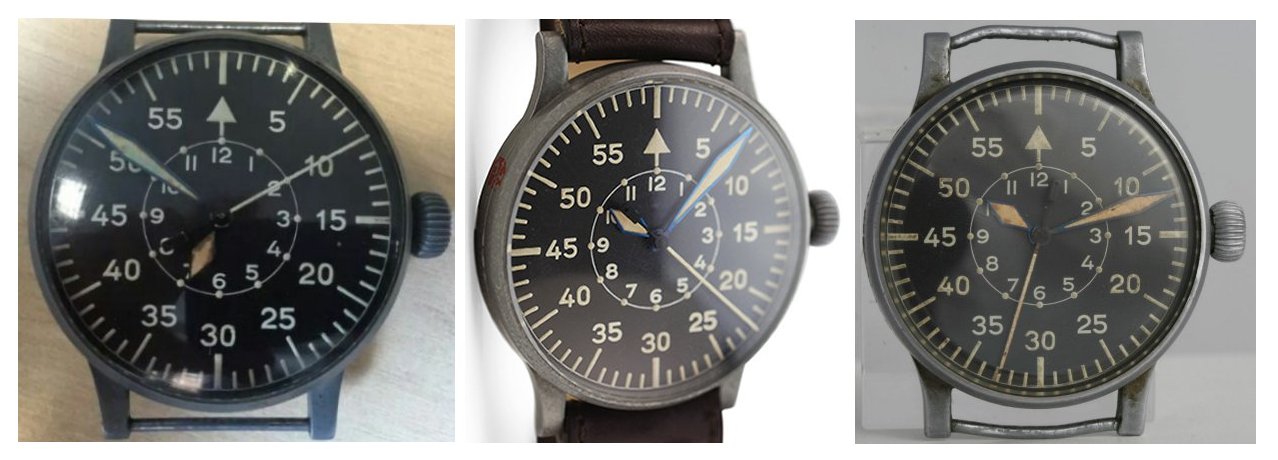
Of these the most rare is
the Stowa – on the company’s contemporary web-site it is stated that total
production may have been as little as 42 pieces!
And here are the four
movements not already shown, left to right: IWC; Laco; Wempe; Stowa

The stainless steel cases
were often finished in grey paint/lacquer and the Reichsluftfahrtministerium
reference number, FL 23883 was
commonly stamped into the side of the case at the 9 o’clock position. The serial number (Werk nr.) was stamped into
the outer face of the rear cover.
These watches did not
remain in the possession of the Luftwaffe flyers – they were issued to them,
mission by mission, to be returned on safe arrival back at base.
An impressive watch by
virtue of the clarity of the dial layouts and the case size. In recent times
there has been enough interest for all the original manufacturing houses/brand
names, excepting A Lange & Sohne, to be offering ‘re-interpretations’ (of
both the A and B Types) some of which look very much like the originals, but
which are somewhat smaller in overall dimensions.
Monday, 11 September 2017
Christiaan van der Klaauw
Prompted by my research and writing on George Margetts – see
here
- I have been looking at the Astronomical Watches of Christiaan van der Klaauw.
Van der Klaauw produced his first astronomical
clock in 1974. Watch manufacture
followed twenty years later with the Satellite
du Monde model. This featured time,
day, date, moon-phase and noon-location indicator. Just in time for the new millennium, the Planetarium model followed, claimed as embodying,
“the smallest mechanical planetarium in the world.”
Planetarium models
remain in production along with other current model families based on either moon
phase or the stars.
Much as I admire the skills of the ‘old’ makers of pocket
watch-scale astronomical pieces, I think I am even more impressed by what CVDK
achieves with these relatively small wristwatches.

You may well find yourself spending quite a lot of time on
this website: http://www.klaauw.com/eng
Thursday, 20 July 2017
George Margetts (1748-1804)
I wrote an extensive article last year on George Margetts. His life and work are intriguing – with technical/craft skills
contradictions, biographical uncertainties, business vicissitudes, possible
deceptions, but, nevertheless, endeavour across a range of horological and
scientific disciplines.
Margetts’s output includes
decorative, multi-function watches, Marine Chronometers, clocks and watches
with astronomical functions, calculating instruments and published writing
based on complex arithmetical calculations.

Here is an example of an extant verge:

© Trustees of the British Museum
Number
|
Date
|
Description
|
Notes
|
Unknown
|
c1778
|
Astronomical,
gold-consular cased verge. Diameter –
55.2mm.
|
The
dial shows the positions of the sun and the moon in the zodiac throughout the
year, the stars visible each night, the age of the moon and the times of high
tide at various ports around Great Britain. The whole dial rotates clockwise
once per day, together with the solar and lunar indicators, but over the
course of a year both solar and lunar hands regress at different rates to
show the position of the sun and moon in the zodiac. Effectively, the dial
rotates once in a sidereal day - 23 hours, 56 minutes, 4 seconds - and the
solar and lunar hands rotate once in a solar and lunar day. In the collection of The British Museum
|

The article includes a table with details/illustrations of 27 extant horological pieces attributed to Margetts.
Margetts’s story involves innovation contrasting with the
more mundane. His ultimate potential
seems to have been unfulfilled and I wonder if his lack of success stemmed from
technical shortcomings, lack of commercial focus or a paucity of ability to
present himself and his ideas effectively - for example in his dealings with the Board of Longitude.
But, whatever might have been
possible, there can be no denying that his Astronomical Watches were very
expertly designed, are nicely evocative of his period and remain aesthetically
triumphant.
Friday, 30 June 2017
Fathers and Sons - Again
My latest research project
has disclosed yet another instance of an enterprising, industrious father who
built a business and reputation over several decades, and a son who presided
over the rapid decline of that business and the loss of the family’s wealth. I don’t go looking for such sagas and must
conclude that the scenario was not so uncommon in the English horology trades
of the nineteenth century. See also
With this maker – as with
Ralph Gout, about whom I wrote in Antiquarian Horology, June 2016 – the son
lacked the father’s craft skills as well as business acumen. As a result it was under the father’s name
that the business was carried on after his death. This assured a maintenance of reputation for
a while and demonstrates that the concept of a trusted, quality ‘Brand’ was as
commercially important in Victorian times as it is today.
My new subject managed to
get through a seven figure (in current value terms) legacy in just 11
years. There are indications that this
came about through overtrading with a reliance on high sales volumes with small
profit margins, the carrying of excessive amounts of stock and a move to
high-overheads premises. There is however
also a strand which is all too typical of late Victorian urban society – chronic ill
health brought about by environmental factors.
The son contracted TB and was forced to relocate to the coast, where he
nevertheless died decades short of his three-score-and-ten and no longer a
well-known watchmaker/retailer and jeweller, but a humble boarding house
keeper.
I am aiming to publish a
substantial article on this watchmaking family in the autumn/winter.
Thursday, 8 June 2017
Rentzsch and Berrollas
Since my last post here, I have finalised an article on
Rentzsch. This includes some interesting
new information which has come to light as a result of contact from Michel
Reymond as he researched an article on the Australian watchmaker, John
Forrester. Forrester emigrated from
England in 1837 and set-up in business in Sydney the following year. In an advertisement he includes the boast,
“Twelve years Foreman to Sigismund Rentzsch, Watch Maker to the Queen and Royal
Family, St. James Square, London.” My
thanks to Michel and I look forward to seeing his piece on Forrester. My article, entitled, The Novel Technology of Sigismund Rentzsch, features in the September 2017 issue of Clocks Magazine.
Volume 38, Number 2, (June 2017), of Antiquarian Horology, journal of the Antiquarian Horological Society, includes my new article on Joseph
Anthony Berrollas. Possibly born in the
same year as Rentzsch and also an immigrant to nineteenth century England,
Berrollas was highly innovative though not very successful in commercial terms.
Both Rentzsch and Berrollas worked on distinctive
versions of keyless winding and they are associated with some of the most
significant watchmaking names of the early nineteenth century: Rentzsch
employed a young Peter Ingold and Berrollas worked with the London retailer,
Viner, and the leading Liverpool makers, Robert Roskell and Peter Litherland.

Berrollas Alarm Movement, courtesy of Worthpoint
Thursday, 18 May 2017
Another Innovator
A recurring interest of mine is in watchmakers who
acquired the expensive habit of wanting to innovate rather than manufacture
readily marketable conventional timepieces.
Time and again this led to the maker having more substantial references
in the Bankruptcy Notices section of such as The Gazette than in the horological records published by Britten,
Baillie and Loomes. Sigismund Rentzsch
is a bit different: the novelty of some of his technology was a factor in his
achieving the accolade, ‘King’s Clock and Watch-maker in ordinary’, and his
business was sufficiently profitable to support a personal ‘productivity’ which
resulted in a family that included no less than fifteen children! However, his second wife, Mary, who bore
eleven of the offspring, continuing the business (at 13 Regent’s Street) after
Sigismund’s death, did find herself obliged to make a bankruptcy assignment in
September 1848.
After a good deal of research I am finalising a full
article on Rentzsch’s life and work. Meanwhile,
I notice that David Penney has a nice-looking cylinder for sale on his Antique
Watch Store website:

Subscribe to:
Posts (Atom)